


When carbon, not grease, is the problem
Most kitchen extraction cleaning is about grease — a soft, sticky film that the right chemical and hot water rinse will lift. Charcoal grills are different. The smoke and high heat carbonise fat and food particles into a hard, brittle black crust that bonds to stainless steel and will not dissolve in the standard clean.
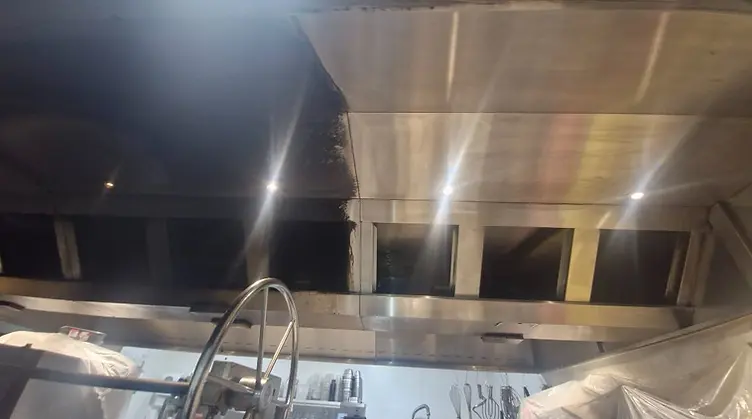
The image below is typical of what we encounter on high-volume charcoal lines: a single canopy, half left in its working state, half restored after treatment.
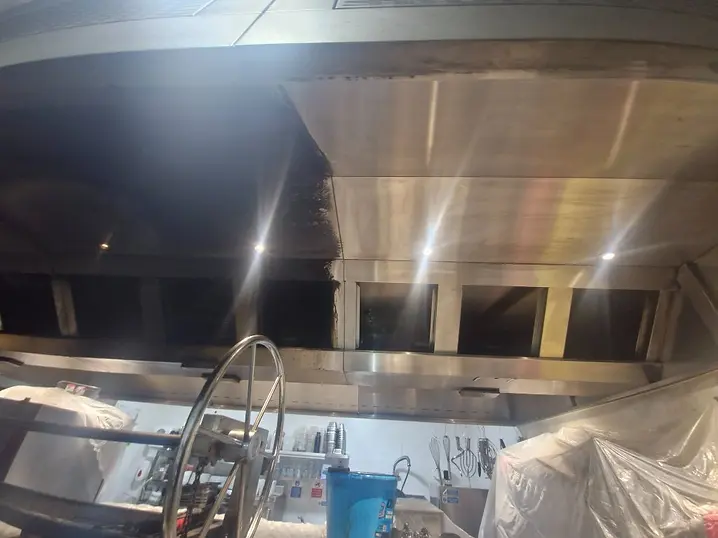

The left side is pure carbon — matte black, light-absorbing, and thick enough to flake off in sheets. The right side is the same steel, brought back to a reflective, food-safe finish.
Why charcoal carbon is so stubborn
Carbonised residue behaves differently to grease in three ways that dictate how it must be removed:
- It is bonded, not sitting. Heat has effectively brazed the residue onto the canopy panels and filter housings. There is no liquid film to cut through.
- It is abrasive. Scraping it dry scours the steel. Done wrong, you score the canopy, creating pits that harbour bacteria and catch future carbon faster.
- It hides in the gaps. Carbon migrates into filter slots, behind baffle plates and up into the duct connection, where it continues to constitute a fire risk even when the canopy face looks acceptable.
Left in place, this build-up cuts airflow, overworks the fan, and provides the fuel load that turns a small kitchen flare-up into a serious duct fire.
How we remove it
Our process for carbon-heavy charcoal canopies follows the TR19 methodology but is adapted for the harder residue.
1. Contain the area first
Before any chemical touches the canopy, we wrap surrounding equipment in protective sheeting — you can see it in the cover image. Carbon removal is messy; carbon that loosens and drops into a service area, onto a burner, or into a prep zone is exactly what we are there to prevent.
2. Soften and lift, never scrape
We apply a dedicated caustic-heavy degreaser at the correct temperature and dwell time to break the carbon bond chemically rather than mechanically. The aim is to turn the brittle crust into a soft paste that can be flushed — not to attack it with a scraper and mark the steel.
3. Agitate at the filter housings
The filter slots and baffle gaps hold the heaviest carbon because that is where airflow forces the particulate to settle. We remove the filters themselves for separate soak-and-pressure cleaning and treat the empty housings while they are open and accessible.
4. Extract the residue by vacuum, not spread it
Loosened carbon is wet-extracted and vacuumed out rather than wiped across the surface. Wiping redistributes the paste; extraction removes it from the kitchen entirely.
5. Detail, polish, and verify
The canopy is brought back to a reflective stainless finish, light fittings are cleaned (the three recessed LEDs in the image are a good indicator — when they read bright and clean, the panel around them usually is too), and the cleaned surface is inspected against the uncleaned side by side.
The compliance angle
A carbon-heavy canopy is not just a hygiene issue. Under TR19 Grease Hygiene Management and the requirements of most insurers, the internal surfaces of the extraction system — canopy, filters, duct, and fan — must be cleaned to a verifiable standard, not simply "visually improved." Our work on charcoal lines is photographed before and after, documented in the post-clean report, and issued with the compliance certificate your insurer and environmental health officer will ask for.
If you run a charcoal-grill kitchen
Charcoal lines need to be on a shorter cleaning cycle than a standard kitchen. We typically schedule high-volume charcoal sites quarterly rather than the standard twice-yearly cycle, because carbon deposits faster and harder than grease alone.
If your canopy is already at the state shown on the left of the image, book a strip and restore clean before the next service — and ask for a post-clean report with before-and-after photography so you have evidence of compliance on file.
Contact us to arrange a charcoal-grill extraction clean or to set up a quarterly maintenance schedule.